
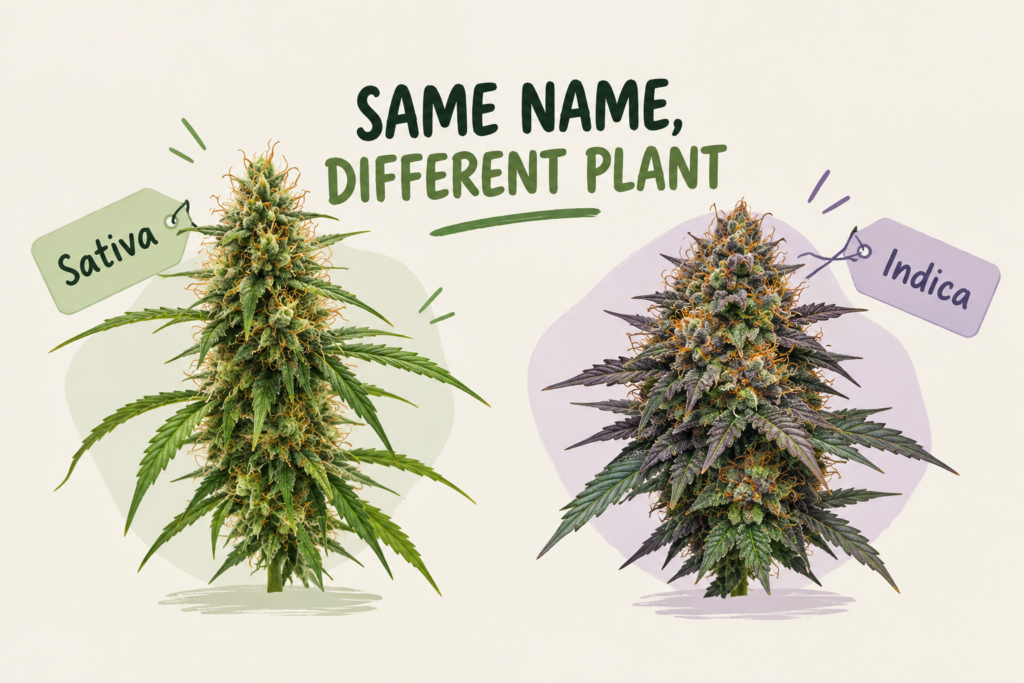
Anyone who has spent time comparing cannabis strain listings across different websites has probably run into the same problem: two pages claim to describe the same strain, but the genetics, effects, and even the indica/sativa classification don’t match. This isn’t usually an error on any one site’s part. It’s a structural feature of how cannabis strain names get assigned — and understanding why makes it much easier to evaluate strain information critically.
What Is a Cannabis Strain Name?
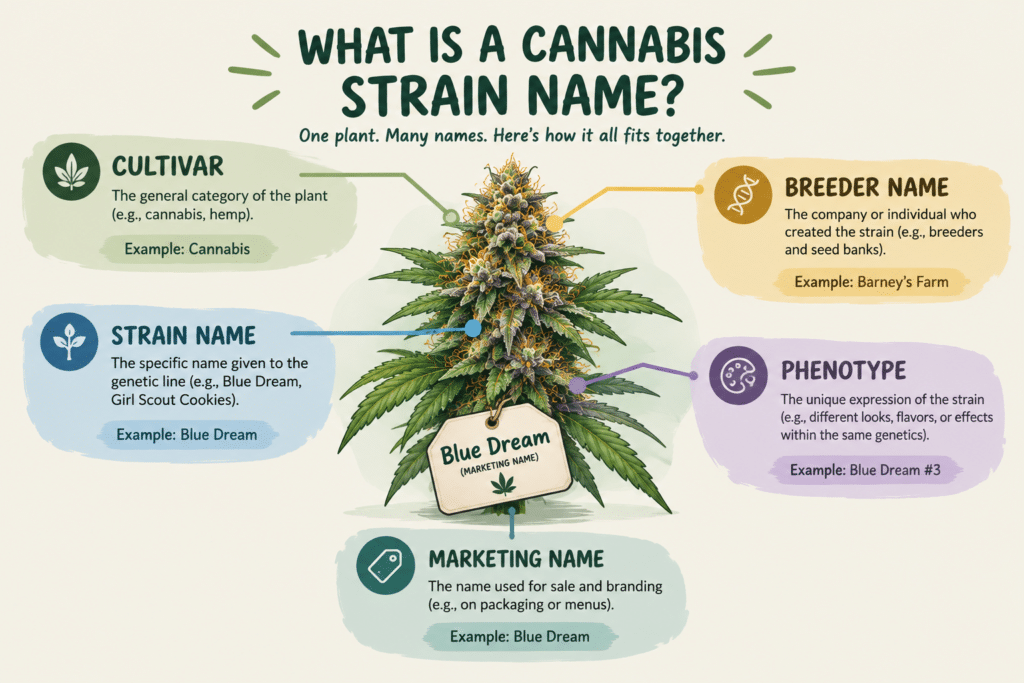
Cannabis strain names and verified genetics are not the same thing, even though they’re often treated interchangeably.
- A cultivar refers to a specific, deliberately propagated plant variety — in cannabis, this typically means a genetically stable line maintained through clones or a stabilized seed line.
- A strain name is simply the label attached to that cultivar for identification and marketing. It can be assigned by the breeder, adopted informally by growers, or applied by a retailer.
- A breeder name identifies who created or released the cross, which matters because the same strain name has sometimes been used independently by different breeders for unrelated crosses.
- A phenotype designation refers to a specific expression within a genetic line — for example, “Phenotype 3” or a grower-assigned nickname for one particular plant selected out of a batch of seeds from the same cross. The distinction between phenotype and genotype is worth understanding on its own, since it explains why siblings from the same cross can look and smell different.
- A marketing name may be applied by a dispensary or brand for a product line, sometimes without any connection to the original breeder’s naming at all.
None of these terms guarantee that two products with the same name share the same genetics. That distinction is the source of most of the confusion discussed below.
How Cannabis Strains Get Their Names
Cannabis strain names come from a range of different naming practices, and there’s no single standardized system across the industry. Common approaches include:
- Breeder-created names, chosen by whoever developed the cross, often referencing the parent strains or a theme the breeder wanted to establish
- Phenotype selections, where a grower picks a standout plant from a batch and gives it its own name, even though it shares genetics with siblings that were never named
- Parent-line references, where a name directly signals lineage (e.g., a hybrid named to echo both parent strains)
- Descriptive names based on appearance, aroma, or reported effects — colors, flavors, and sensory associations are common
- Geographic or cultural references, tying a name to a real or implied region of origin
- Marketing and branding decisions, where a name is chosen primarily for commercial appeal rather than genetic accuracy
- Community-adopted names, where a strain becomes known by an informal name through word-of-mouth or online discussion, sometimes replacing or existing alongside the breeder’s original name
Because there’s no central registry enforcing any of these conventions, a name can be reused, adapted, or misapplied at almost any point along this chain.
Why Cannabis Genetics Can Be Difficult to Trace
Several factors make lineage tracing harder in cannabis than in more formally regulated agricultural sectors:
- Undocumented crosses. Not every breeder publishes or preserves detailed records of a cross, particularly in the earlier, less commercialized eras of cannabis breeding.
- Renamed cultivars. A cultivar can be renamed when it changes hands, moves to a new market, or gets rebranded by a new seller — sometimes with no public record connecting the old and new names.
- Lost breeding records. Cannabis prohibition for much of the 20th century meant many crosses were never formally documented at all, since keeping detailed records carried legal risk.
- Clone-only lines vs. seed lines. A clone-only cultivar propagated for years through cuttings can diverge in practice from a seed line sold under the same name, especially if the seed line was later stabilized or crossed further.
- Informal naming across regions. The same genetic line can pick up different regional nicknames, while, separately, the same nickname can be applied to genetically unrelated plants in a different region.
The result is that strain lineage information ranges from rigorously documented (in cases where a breeder maintains detailed records and reputable seed banks corroborate them) to essentially unverifiable folklore.
The Difference Between a Name and Verified Genetics
A strain name alone does not establish genetic lineage. Verified genetics require some combination of:
- Breeder documentation — the original breeder’s own record of the cross, ideally published at the time of release rather than reconstructed later
- Consistent third-party corroboration — independent seed banks, testing labs, or genetics-focused databases reporting the same lineage
- Traceable origin — a clear line from the original cross to the specific plant or seed line in question, rather than an assumed connection based on name alone
Retailer descriptions, by contrast, are frequently written by staff who are relaying what they were told, or what a previous listing said, rather than independently verifying anything. That doesn’t make retailer information worthless — it’s often accurate — but it sits at a different evidentiary level than a documented breeder record, and it’s worth knowing which one you’re actually reading.
How Similar or Identical Strain Names Can Cause Confusion
This is where the practical impact of loose cannabis strain names becomes most visible. Two cultivars can carry the same or nearly identical name while having entirely different genetic origins, for reasons including:
- Two breeders independently choosing the same evocative name (candy and dessert-themed names are especially prone to this, given how many breeders draw from the same pool of flavor associations)
- A name being reused deliberately, capitalizing on the popularity of an existing strain name without any genetic connection to it
- A cultivar being informally renamed in a new market and later re-released under its original name by an unrelated party
- Regional naming divergence, where growers in different areas apply the same nickname to different local phenotypes
For a reader trying to research a specific cultivar, this means that finding multiple sources using the same strain name is not, by itself, confirmation that they’re describing the same plant. It’s necessary to check whether those sources agree on breeder, parent genetics, and other specific details — not just the name.
Why Phenotypes Can Add Another Layer of Confusion
Even within a single, well-documented genetic line, phenotype variation adds complexity. A cross between two parent strains typically produces offspring with a range of characteristics — different terpene expression, growth structure, color, and potency — even though every plant in that batch shares the same genetic cross. Peer-reviewed research on cannabis genotypes has found no consistent physiological pattern tied to shared vernacular strain classifications, which is a more formal way of confirming what growers have long observed anecdotally: a shared name doesn’t predict a shared physical profile.
When a grower selects a standout individual from that range and gives it its own name, that phenotype name describes one specific expression of the underlying genetics, not a separate genetic line. Two phenotypes from the same cross can look and smell noticeably different while being, genetically, siblings. This is a normal and expected part of breeding, but it means a phenotype-specific name should not automatically be treated as evidence of an entirely different lineage — and conversely, a shared parent-line name doesn’t guarantee that two phenotype selections will behave identically.
How to Research Cannabis Strain Lineage
For growers, buyers, or researchers trying to verify a specific cultivar, a practical approach looks like this:
- Identify the breeder or original source. Start with who actually created or released the cross, if that information is available at all.
- Look for documented parent genetics. Check whether the breeder or a reputable source has published the specific parent strains, rather than a vague description.
- Compare multiple reputable references. A single listing is not sufficient — cross-check against independent seed banks, genetics databases, and breeder statements where possible.
- Check whether the name has alternative spellings or aliases. Naming inconsistency (spacing, capitalization, alternate spellings) can obscure whether sources are even discussing the same cultivar.
- Distinguish breeder information from retailer descriptions. Note which category each source falls into, since they carry different levels of reliability.
- Look for consistent lineage information across sources. Agreement across multiple independent, reputable sources is a stronger signal than a single confident-sounding claim.
- Treat unsupported genetic claims cautiously. If a claimed lineage appears in only one place, with no corroboration and no visible sourcing, it’s reasonable to treat it as unconfirmed rather than settled fact.
Why Accurate Strain Information Matters
Reliable lineage and naming information serves different purposes depending on who’s using it. Growers rely on accurate genetics to anticipate plant structure, flowering time, and cultivation requirements. Breeders depend on clear records to protect the integrity of their own lines and to avoid unintentionally duplicating or misrepresenting someone else’s work. Researchers and industry analysts need consistent naming to track genetic trends across the market. And consumers benefit simply from knowing that what they’re buying or growing is accurately described, rather than assuming a name guarantees consistency it may not actually have.
A Real-World Example: Red Hotz
These naming and lineage issues aren’t just theoretical. They show up regularly when researching individual, currently available cultivars — including cases where a popular name has been used by more than one breeder for genetically distinct crosses, sometimes with disagreement even on basic classification like indica versus sativa lean. For a documented example of exactly this kind of naming overlap, see how this plays out with Red Hotz, where multiple independently released cultivars share the same name but not the same genetics.
Frequently Asked Questions
Does a cannabis strain name guarantee specific genetics? No. Cannabis strain names are labels, not verified genetic records. The same name can be used by different breeders for unrelated crosses, so a name alone doesn’t confirm lineage.
What’s the difference between a cultivar and a strain name? A cultivar refers to the actual, genetically consistent plant variety. A strain name is simply the label attached to it, which can be assigned by a breeder, adopted informally, or applied by a retailer — and doesn’t always stay tied to one specific cultivar over time.
Why do two sources sometimes describe the same strain name differently? Often because they’re actually describing genetically different plants that happen to share a name, rather than disagreeing about the same plant. This is common with popular, evocative names that multiple breeders have used independently.
Are phenotypes considered separate strains? Not genetically. A phenotype is one individual expression within a shared genetic line, so phenotype selections from the same cross are genetic siblings, even if they’re given distinct names and look or smell noticeably different.
How can I verify a strain’s actual genetics? Look for breeder documentation, compare multiple independent and reputable sources, and treat single-source, uncorroborated claims with caution. Consistency across independent sources is a stronger signal than any one confident-sounding description.